
If fiber has not reached your address yet, fixed wireless is probably the next best thing you can get out here. But “fixed wireless” covers a wide range of quality, and most of the difference comes down to one question almost nobody asks: is the provider using licensed spectrum or unlicensed spectrum?
Here is what that means and why it matters at your kitchen table.
How fixed wireless works
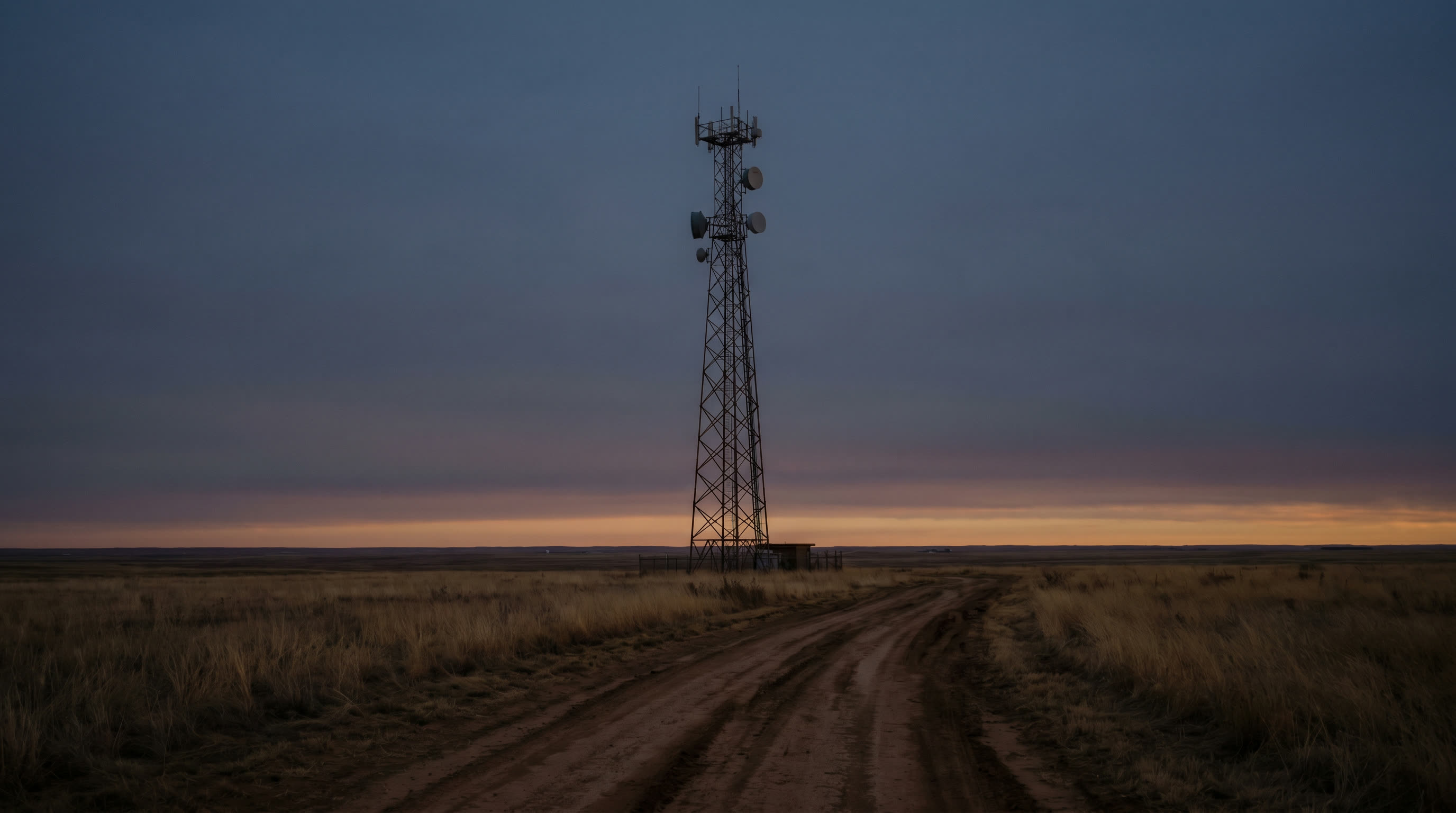
The basic setup is simple. The provider puts equipment on a tower. A technician mounts a small antenna on your roof or a pole at your place and points it at that tower. The two talk to each other over radio waves, and the tower connects back to the internet over fiber. No line buried to your house, which is why fixed wireless can reach a farmstead years before fiber does, and why an install takes a day instead of a construction season.
The antenna is fixed in place and aimed. That is the “fixed” part, and it is a real advantage over the cell service on your phone. A dish aimed straight at a tower five miles away can hold a strong, steady signal in conditions where a phone in your pocket would show one bar.
The catch is that everything rides on the radio link. If that link is clean, the connection is solid. If that link is fighting interference, everything you do on the internet fights it too.
Licensed vs unlicensed: whose airwaves are these
Radio spectrum is split into slices of frequency, and the FCC decides who gets to use each slice.
Unlicensed spectrum is the public pool. Anyone can transmit on it without permission. Your home Wi-Fi lives there, along with baby monitors, garage door openers, wireless cameras, and every other ISP in the area who bought the same off-the-shelf gear. Nobody has to coordinate with anybody. It is the radio equivalent of a party line.
Licensed spectrum is different. The provider holds FCC rights to a specific slice of frequency in a specific area, and nobody else is allowed to transmit on it there. If someone does, the FCC will make them stop. That slice belongs to one operator, full stop.
Building on licensed spectrum costs more and takes real engineering work. Plenty of providers skip it and run unlicensed gear because it is cheap and quick to deploy. It also works, sort of, until it doesn’t.
Why licensed wins where it counts
Interference is the whole ballgame. On unlicensed spectrum, your connection shares the air with whatever your neighbors and competing providers put up, and none of it is coordinated. When a new tower or a new camera system lights up nearby, your service can degrade overnight, and your provider can do very little about it because the other guy has every right to be there. On licensed spectrum, the air is clean by law. The signal your antenna was tuned to on day one is the signal it gets on day one thousand.
Consistency at busy hours. Interference problems show up worst when everyone is home and online. Evenings, weekends, bad-weather days when the whole county is inside streaming. That is exactly when you want your connection to hold, and exactly when an unlicensed link is most likely to wobble.
It can actually be engineered. Because a licensed operator knows exactly what is on their frequencies (nothing but their own gear), they can design each link deliberately: power levels, antenna alignment, capacity per tower. An unlicensed operator is guessing about an environment that changes without notice.
It matters more for work. If your internet carries a home business, remote work, video calls with a doctor, or the point-of-sale system at a shop in town, a link that degrades unpredictably is a real cost. Licensed spectrum takes the biggest source of that unpredictability off the table.
Questions worth asking any wireless provider
You do not need to be an engineer. Three questions get you most of the way:
- Is the wireless service on licensed or unlicensed spectrum? A straight answer to this one tells you a lot. So does a dodge.
- Who does the install and who shows up when something breaks? A local tech who is an actual employee beats a contractor from three hours away.
- What does the tower connect back to? A tower fed by fiber has room to grow. A tower fed by another wireless hop is splitting a smaller pie.
Where we stand
Plains Internet runs licensed fixed wireless alongside our fiber network, built and maintained by our own techs here in the Panhandle. If you want to know what we can do at your address, check your address, look over our plans, or call (806) 340-7320. A real person answers.
See plans
Wondering what we can install at your place?
More from the team
All posts-
Game Day Streaming Without the Buffer Wheel
How to get the big game streaming smoothly when the whole family is over, with a few checks you can do before kickoff.
-
Extending Wifi to the Shop, Barn, or Bunkhouse
Your options for getting internet coverage out to an outbuilding, from mesh systems to point-to-point wireless, and when each one makes sense.
-
How the Panhandle Got Its Towns (and Why They Sit Where They Do)
Railroads, ranches, and a courthouse fight put nearly every town up here on the map inside about twenty years. That history still explains your internet options.